
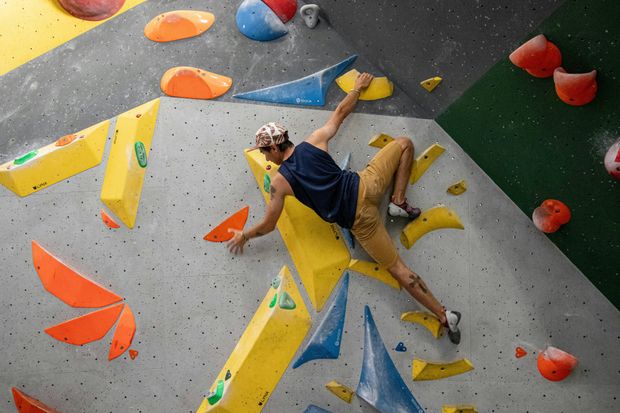
As a teenager, our daughter became fanatical about rock climbing. Since my wife and I were spending untold hours at the climbing gym anyway, we decided to take it up too.
Is it unusual to start rock climbing in your forties? Yes.
Did it look pretty? Let's just say that the impressive climber in the photograph above is not me.
You don't know humility until you've watched a seven-year-old scamper past you while you grunt and sweat your way up a V1 boulder. (For reference, V1 is pretty easy.)
After I'd been climbing for about a year, a close friend joined me at the gym. Watching the other climbers, he asked, in the kindest way possible, "Why are they all better than you?"
I proudly told him, "I'm less bad than I was last year."
It was perhaps the first time I'd really thought about it: I like being a beginner at something.
But being a beginner can also be hard and unsettling, especially at an age when we've spent decades becoming good at so many other things.
We've built careers, raised families, developed expertise, and figured out how to navigate much of life. We know what we're good at. And, perhaps more importantly, we've learned to avoid the things we're not.
So why would we willingly put ourselves in situations where we're awkward, incompetent, and occasionally ridiculous?
More importantly, as we become more accomplished, do we also become less willing to risk looking foolish?
I have a theory. It's completely uninformed by science and based entirely on my own experience, so take it for what it's worth.
As we get older, we become pretty good at a relatively small number of things. Through our careers, hobbies, and relationships, we develop expertise. People come to respect us for it. Our colleagues seek our advice. Our kids see us as competent adults. At dinner parties, there are subjects where everyone knows we're the person to ask.
And let's face it, that feels good.
But I wonder whether there's a downside. The more comfortable we become being good at things, the less willing we may be to try things we're bad at.
Before long, we risk becoming very accomplished versions of increasingly narrow selves.
Which brings me back to why I love being a beginner.
There's the excitement of trying something completely new, the satisfaction of getting better surprisingly quickly (at least at first), and the pleasure of discovering a whole world I knew almost nothing about.
And the science is on our side. Learning new skills challenges our brains to form and strengthen neural connections. If we're learning something physical, we're also challenging our strength, coordination, and agility. It turns out that doing something new isn't just fun. It's good for us.
And I'll admit there's something else I enjoy. Take rock climbing as an example. It's one of those activities we tend to associate with younger people. There's a particular satisfaction in discovering that I can still do it, even if I'm not especially good at it.
I'm not going to become a world-class climber. But that's hardly the point. A decade ago, climbing wasn't part of my life at all. Now it is. And that feels like an expansion of what's possible, rather than another concession to getting older.
Same with surfing. My wife and I got into this a few years ago. Objectively, we're terrible. But we're out there with a bunch of thirty-somethings, hanging out in the water, connecting with a totally different demographic than we're used to, and challenging ourselves in new ways.
And we're getting better (a little) and having fun (a lot).
Of course, I recognize that putting yourself in a situation where you're not very good at something can be challenging. So here's what I'd suggest.
Enjoy being bad at something. Forget how you measure up against everyone else. The real satisfaction comes from seeing how much better you are than you used to be. When you're learning to surf, the first time you catch a little blue wave instead of just riding the whitewater feels like an Olympic achievement. Nobody else in the ocean is impressed. You couldn't be happier.
Follow your curiosity. We love discovering new restaurants, travelling to unfamiliar places, trying interesting wines, and watching movies we've never seen. Why should our hobbies and activities be any different? Yes, learning something new takes a little more effort than ordering an unfamiliar bottle of wine. But the pleasure of discovery is much the same. And sometimes the things you never imagined yourself doing become the things you most look forward to.
Meet people you wouldn't otherwise meet. This might be my favourite part. Every new activity opens the door to a community of people with their own passions, language, humour, and ways of seeing the world. I've discovered entire subcultures I barely knew existed. And there's something wonderful about finding yourself among people who don't know or care what you've accomplished in the rest of your life. You're just another beginner, trying to figure things out.
I don't know how good I'll ever become at climbing or surfing. Probably not very. There are still seven-year-olds who can climb circles around me and thirty-year-olds who can catch waves I wouldn't dream of attempting.
But I'm better than I was. I've met people I wouldn't otherwise have met. I've discovered things I didn't know I'd enjoy. And I've added a couple of wonderful new dimensions to my life.
That seems like a pretty good return on the investment of being terrible at something.
There's an enormous amount of life still waiting to be discovered, and being a beginner is one of the best ways to find it.
So here's a question: what might you be missing by not trying?


